This year the CO2 in the atmosphere reached the level of 392 ppm. The level of CO2 for the past 800,000 years was at its highest about 280 ppm, which is where it was before the industrial revolution began around 1800. By 1950, the CO2 level was at 315 ppm and rising at about .5 ppm per year. Now it is rising at about 2.5 ppm per year. So the rate of increase has itself increased. Unabated, we will be at 415 ppm by 2020, and about 470 ppm by 2050.
OK, well and good, but what does that really mean? We have to look at truly ancient climates to get possible answers to that question. We have to look past the relatively recent cycle of ice ages and interglacial periods of the last 800,000 years. We need to look at the ages where CO2 levels were about what they are now and where they might be if the CO2 levels are allowed to rise unabated.
If we go back about 3.5 million years we get to the climate age called the Pliocene. The Pliocene lasted from approximately 5.5 million years ago (mya) to about 2.5 mya. Over this time, the continental drift caused the Mediterranean Sea to be formed and the Isthmus of Panama to rise and connect North and South America.
The seas were warmer and the climate was +2.5C (+4.5F) warmer than today. There was no Greenland Ice Cap, and no Arctic Ice at all. The oceans were 25m (80ft) deeper than they are today. The CO2 levels were about 390 ppm.
Since we are already at the Pliocene carbon dioxide levels, the question really is "what is going to prevent the duplication of the Pliocene climate from being recreated?". A second question is "how long will it take for a Pliocene like climate to establish itself?"
Let's look at the first question. At this time, no process has been identified that will likely prevent the establishment of a Pliocene like climate. The identified feedbacks mostly amplify and accelerate current warming trends. Those feedbacks include 1) loss of Arctic albedo (ice reflectivity), 2) melting permafrost adding carbon dioxide and methane to the atmosphere, and 3) release of methane from shallow undersea formations called clathrates. Of course, mankind is still accelerating its burning of fossil fuels worldwide.
The climatologists differ significantly on their estimations of how long for warming to take effect. The disturbing feature of their estimations is that for the past ten years their estimations have gotten progressively worse. Each time they update their estimates, they are more dire. The ocean levels rise higher and faster. A recent update in Ice News, said that oceans may rise up to 5 ft by 2100.
Can that be right? 5 ft? That would flood much of the food producing areas of the world located in river deltas. The Nile delta, Mississippi delta, Ganges delta (Bangladesh), Mekong Delta, Danube delta, and so many more would be mostly underwater if that happened.
For that to happen the Greenland Ice cap would have to start melting at a very fast rate. To rise 60 inches by 2100 it would have to rise at over 1/2 an inch per year, or about 150mm per year. We have been rising at about the rate of 2.5 mm per year in recent years. The climatologists are expecting Greenland to start melting at a significant rate in the next decade or two. The oceans may only rise 6-12 inches by 2050. What can cause Greenland to start melting real fast?
To answer that we have to look at the position of Greenland. The Arctic Ocean is to the north. Much of its weather comes from the north and northwest which have been perpetually ice covered for hundreds of thousands of years. Soon, though, the Arctic Ocean will be ice free during the summers, and will be absorbing sunlight and getting warmer. As that happens, then Greenland will be surrounded by open ocean at above freezing temperatures. No matter what direction the weather comes from it will bring above freezing warm air to Greenland for a season each year.
With each passing year, the Arctic Ocean gets warmer from absorbing sunlight. And each passing year, the melt season for Greenland gets longer and warmer. Greenland melting will go into overdrive. It will go into hyper-melt mode. When that happens, then we will likely start seeing the seas rise at 100 mm to 200 mm per year.
Is this for absolute certain to happen? Unfortunately, our knowledge is still developing, and we don't know everything. As of now, no one can point to any natural process that can stop this. Even if mankind stopped dumping CO2 into the atmosphere, these events are likely to happen. Maybe if mankind decided to remove CO2 from the atmosphere to lower levels to 350 ppm or lower, that might work.
The second question was "how fast". Even if oceans rise only 4 ft, or 3 ft, or 2 ft, does not mean that the processes won't continue and give us the same result. For some reason, the year 2100 has been used as projecting the results of global warming trends. However, the global warming will not stop at 2100. In fact, the accelerated pace of ocean level rising that is expected to occur from 2050 to 2100 will still go on and accelerate even further.
Remember the Pliocene oceans were 80 ft deeper. Greenland was free of ice, and the Antarctic had much less. The estimation for how long it will take the whole of the Greenland ice cap to melt (assuming mankind does nothing to reduce CO2 to 350 ppm or less) varies for 2,000 years to 300 years. The estimated 5 ft of increased ocean rise will mostly come from Greenland. That will represent about 20%-25% of Greenland's mass. At that rate, then Greenland's ice would be gone around 2400.
Antarctica will have started melting, so a rise of 30 ft to 40 ft by 2400 seems reasonable, maybe more. How long to reach an increased depth of 80 ft? That is difficult to answer because the climate dynamics that will be created in just the next hundred years may be very different. Ocean currents may change. Ocean temperatures will definitely change. Ocean chemistry will change. All these can effect the carbon cycle and the water cycle, and thus effect climate. Hopefully, processes will be altered or uncovered that will slow down, halt, or reverse the warming climate trend caused by higher CO2 levels.
Global Warming is undoubtedly the greatest challenge that mankind can face. People have difficulty planning ahead even a few years. A decade is beyond most people's ability. To cope with Global Warming people have to deal with decades and centuries. People live in cities mostly, and are cut off from the natural world around them. Even when it is nearby, they tend not to notice. Lake Michigan was once a very cold lake to swim in, even in August. Now it is wonderfully comfortable by July. It has increased in temperature 12F since the 1960's. The changes are around us. The changes will be more significant in the future and probably much less welcome.
Sunday, May 15, 2011

Thursday, May 5, 2011
Starting Gaia Watch Blog...
Hello World
I am starting a new blog where I will report and discuss observations, developments, and new understandings of what is happening to our planet Earth. My interest in the world started, like everyone, at my birth. As a child, I had great curiosity and interest in everything. Being raised in a conservative Catholic school, I learned that the Earth was created around 4,000 BC, on a Tuesday. I recal being told it happened at 2 PM, although I never understood how that could be calculated from the bible.
Fortunately, I lived in Chicago, and the Field Museum of Natural History was there. In those days, it and all the main museums in Chicago were free. In the summer, I woud get some loose change, take the bus, and spend the afternoon just walking its halls. The Field Museum had the greatest collection of stuffed animals. It seemed all the animals of the world were there, organized in great halls. A hall for cats. A hall for birds. A hall for reptiles, and one for insects, etc. Several halls were dedicated to mankind, organized by location and culture.
 |
| Gorgosaurus standing triumphantly over the slain carcass of a Lambeosaurus sometime in the Late Cretaceous |
I saw the vastness of life, and the diversity of man. I marveled at how people could live in so many different ways. Being an irish boy living in an immigrant Polish neighborhood, I was already aware that people could be very different. My first first freinds were Polish boys, whose parents spoke only polish. So the ways of South Sea Islanders, or of American Indians, or exotic Tibet, were merely extensions of what I already knew.
Several of the halls was dedicated to prehistoric life. As a young boy, the most captivating was the dinosaurs. In the main hall, a skeleton of a Gorgosaurus was displayed in a carnivore’s victory pose over its, supposedly, recently vanquished prey – a Lambeosaurus. I wondered how these creatures lived, and why. I read books by Edwin H. Colbert, who was the existing expert on dinosaurs. His “Dinosaur Book”, was my favorite. However, even at a young age, I was a skeptic by nature. When Colbert claimed that the Dinosaurs were cold blooded, I did not accept that. In fact, I did not accept them as Reptiles. I felt that they were whole other classification — not mammal, not bird, and not reptile. To me, they were Dinosaurs, unique and amazing.
Close by the hall of the dinosaurs, was a hall about geology. It was my least favorite hall. Rocks, being inert, hold very little interest to a child. There was one exhibit in that hall that caught my eye. It showed a 1/4″ rod, coiled round and round, and had the various ages of the earth and what was happening on ther earth at those times. It showed the cambrian, and the age of fishes, the Ordovician, the Silurian, the Devonian, Permian, Triassic, and all the ages. This coil went round and round many times, a dozen or more at least. At the very end of it, about an eighth of an inch finally came the age of man. A fine tiny sliver was the historic era going back to the ancient Egyptians.
I began to see, at that young age, how tiny and insignificant all mankind was. If mankind ceased to exist, our bodily remains would be so few as to hardly leave a trace after a few million years. As opposed to the remains of sea creatures that built Florida, and laid down the huge beds of limestone that we quarry, our existence is as nothing. Yet, being in Chicago, I saw some of the greatest buildings ever built. The skyscraper started in Chicago, and modern architecure was defined and refined there. Still, these creations would eventually turn to dust, given the enormity of Time.
In time, I grew up, and left behind such childish musings. I got a degree, and then a Masters Degree in Business from Northwestern University Kellogg School. I made a living consulting and helping companies operate better and make more money. Outside of the occassional visit to a museum, thoughts of life and the planet did not occur to me much.
I had a daughter. I took her to the Field Museum, wanting to introduce her to the place that was my mind’s incubator. But, it had changed. It charged money now, and the fee was not cheap. More importantly, though, it had changed on the inside. The great halls of stuffed animals were destroyed, and the information gone. I took my daughter into a recently “renovated” bird diorama that you walked through. I guess it was done to give a viewer a “feel” for the birds environment. I guess they think we don’t have imaginations. What is worse, though, is that the stuffed animals cannot be put out in the open like that. So, all the really good ones, the rare ones, were no longer displayed. The absolute worst, though, was the destruction of information.
In the diorama, a red-winged blackbird was displayed. Pretty. But, no information, other than its common name was given. No latin name. No map showing habitat range. No display of young or female birds, whiich I knew looked different. No display of diet, or beavior, anything else. If that is all I needed, I could show my daughter red-winged blackbirds on the side of the highway. It was horrible. To me, it was as if barbarians had invaded the temple to knowledge, and destroyed it. Marauding Vikings with war hammers and axes could not have done a more devastating act of vandalism.
It was obvious that the hordes of religious fanatics, screaming creationism had descended. The dioramas of Neanderthal man were removed. In the main lobby, a glass case once stood, showing the erect skeletons of the five main apes – Gibbon, Chimpanzee, Orangutan, Gorilla, and Homo Sapiens. As a child, I saw how closely we were related to the other apes. Just take a gorilla’s body, and change the dimensions of it bones, and you would get the Chimpanzee, or the Gibbon, or a Man. The same could be done with all of them. That was an important lesson I wanted to teach my daughter. But, it was removed. When I complained about it, and wondering if it was destroyed. I was shown that it still existed, but hidden away where it could not be seen. This, for a display that was once considered so important that it was displayed in the main hall. I guess science had lost its appeal at the Field Museum. All the displays have been ravaged now, and depleted of information. Whatever is shown now is devoid of context, and without context, facts are meaningless. Fortunately, the American Museum of Natural History is still world class.
But I digress. In 2001, my interest in the planet Earth was awakened by a magazine article. I forget where I read it, but it said that naval observations had shown that the average Arctic summer ice thickness had gone from 17 ft thick in 1980 to 9 feet thick by 1998. I was shocked. A simple computation told me that the Arctic will have a summer ice thickness of zero by 2017. What surprised me at the tiime was that climatologists and their models were predicting 2100 as the time for a summer ice free Arctic. I could not square the naval ice thickness data with the climatologist’s predictions.
It was my effort to understand the naval data and the climatologists that got me thinking again about this Earth, and what is happening to it. The Arctic has rekindled my interest, but many other things are happening that need to be understood. Much of what is reported is often without context, or even wrong. The scientists are not always the best at making things understandable. In fact, their wording is often ambiguous. For instance, an article might read “The Arctic has seen its lowest ice extent since 1979″. To the normal reader, that would mean — The Arctichas seen its lowest extent since 1979 WHEN IT WAS LAST AT THIS LEVEL. When, what the scientist really means is — WHEN RECORDS STARTED BEING KEPT. So, no implication of prior extent being that low – EVER. I will do my best to explain things I come across in clear unambiguous terms. Science is not that difficult, when things are presented clearly.
And so, now, I start my blog. If you like it and find it occassionally interesting, please leave your comments, I want to hear them. I will respond as best I can.
Friday, February 25, 2011
Arctic Losing Winter Sea Ice...New and Alarming Trend..

Recent View of Arctic
Cryosphere Today websiteThe Cryosphere Today website is very interesting, I recommend it. The above image was taken from it. What it shows is actually quite disturbing.
Every winter the Arctic sea ice extends and freezes its normal maximum area of about 14 million square kilometers (msk). That is normal for now. If you go back to 1980, the Arctic normally reached a maximum ice are over 16msk. In any case, the area that was frozen over would be completely covered with ice.
The completeness of the ice coverage can be seen by the color given to the ice by the Cryosphere Today website.

Compare the two images from February 24th 2007 and 2011. See the difference? The 2007 image is a solid purple. That means that the Ocean is completely covered with ice -- 100%. That is good. That is to be expected. After all, in 1980, the average ice thickness was 17 ft, and was primarily multi-year ice.
The 2011 image is NOT solid purple. The Arctic is NOT completely covered in ice. The ice concentration is less than 100%. The colors indicate that the concentration is 95%, 90%, and as low as 80%. Water is actually exposed to the air in those places. If you were to be walking there, you could drown.
This is extraordinary. Remember the image for 2007 shows the condition of the Arctic in the year when a summer ice minimum of 3msk was reached. That was a serious meltback that blew away previous records by one million sq. kilometers! When that happened, climatologists rushed to their models to update them. None of the climate models predicted that huge meltback.
But, even that year showed 100% ice coverage the preceeding winter. This winter is different. What does it portend?
First, I think the there should be a huge meltback this summer, easily beating the 2007 record. I would not be surprised to see a summer ice minimum of 2msk.
Secondly, I see a trend towards less and less winter ice. The loss of sea ice area until now has shown a decrease in area at the margins. Now it is losing ice throughout, and it is doing it in WINTER! If the cold Arctic air cannot freeze the ocean in the winter, then that means that Arctic Ocean is becoming to warm to freeze.
Note Hudson Bay. It did not freeze over until January, two months late. But, it did freeze over. Note that its color is a solid purple, so it ishows 100% sea ice concentration. It may be thin ice, but it covers completely. The Arctic is not doing that.
Now another thing that may be happening is wave action. The Arctic is an ocean which means waves. If the ice is not thick enough, then wave action will break it up. So we might be seeing the development of ice and water mixture, a sort of ocean slushy. This may be just as bad as having the ice melted, from an albedo effect. If you notice, broken up ice floating in water, becomes clear and takes on the color of the water. So, ice reflectivity is lost. Sunlight, when it comes in the spring, will start being absorbed before the ice gets fully melted.
As there is less summer ice, more solar energy is absorbed, warming the ocean that much faster.
Now as the ocean warms, then the winter ice concentration should be expected to decline. Now it is at 95% over much of the area. In future years, may it go down to 90%, 80%, and even lower. If this trend continues long enough, shouldn't we expect to see an ice free Arctic in the winter? It might take several hundred years to reach that condition, but unless something happens to reverse the underlying conditions causing the trend, then how can it be avoided?
Impact on Greenland
The importance of Arctic ice loss is on loss of albedo and the warming of the Arctic Ocean. The reason why that is important is that is where the climate of Greenland is determined. When ice is year around to the north of Greenland, then all the weather coming to Greenland is freezing during the entire year. The ice cap is safe.
However, when the Arctic ocean is open water, it is above freezing. Thus, all weather systems going over it to Greenland become above freezing. Greenland melts. The less ice, and the warmer the ocean, the warmer the air, and the faster Greenland melts.
The climatologists foresaw an ice free summer Arctic happening soon. Maybe as soon as 2020. However, none foresee an ice free WINTER Arctic!. This could mean that Greenland's melt season would be year around. Not just for a few months in the summer.
If that happens -- HYPER MELT time. Now we could be talking about accelerating the melting of Greenlands ice cap by orders of magnitude. To me, an increase of melting by 100 times more the current melt rate would not be surprising.
This may seem extreme, but it is just a matter of deduction. Think about it.
Monday, February 21, 2011
Record Melting of Arctic Ice coming in 2011 !!!
I am forecasting a record meltback of Arctic Ocean ice area for the summer of 2011. In 2007, a record low of Arctic Ice area was recorded - approximately 3 million sq. km. Before that, a "normal" year would see an minimal ice area of about 5 mil. sq. km. This year, I am forecasting a new record low of near 2 mil. sq. km. will be set.
The Significance?
This is significant since ice has a high albedo factor. That is, it reflects most of the suns light and heat back into space. As more and more of the Arctic ocean is ice free, more and more of the sun's heat is absorbed. Thus, the ocean's temperature increases, and less ice is formed in following years. This feedback process has been well underway for the last few decades.
When the Arctic ocean north of Greenland becomes ice free each summer, then the air masses bringing weather to Greenland will be above freezing. In the past, the ocean north of Greenland was ice covered year around. When their is north of Greenland, then the melting of the Greenland Ice Cap will begin in earnest. I believe it will enter what I call "hyper-melt" mode. With the warmer air coming to Greenland for longer summer periods. Then Greenland's ice will melt in earnest. I would not be surprised to see an increase of melting by an order of magnitude.
How Do I know? I regularly go to the Cryosphere Today site maintained by the University of Illinois. This site has satellite images of the Arctic showing the ice coverage. The images of the ice are color coded showing the density of the coverage. Dark purple for complete coverage through light blue for almost no coverage, and black for less than 15% ice. If you look at all previous years for May 1, you will see dark purple over all the Arctic.
Well, for 5/01/2011, you not see dark purple everywhere. You will a lot of light purple, red, yellow, and green. That means that the Arctic ice is not completely covering the ocean. It means that the cold Arctic air is not cold enough to overcome the heat of the Arctic ocean and freeze it over. Therefore, this ice will melt very fast this summer.
These colors you see is a new development. Normally you only see colors other than purple at the edges of the ice. The ice would be solid, except at the margins, where the melting would occur. But now we see large areas of varying ice concentrations. This can only mean that the ice has become too thin to remain structurally sound. That is, the waves of the ocean are breaking it up. It will melt much quicker and more easily.
If you look at the ice area for May 1, 2007, you will see that the ice completely covered the ocean. The Arctic set a record low summer ice minimum. Since 2011 is starting with thinner and less ice coverage than in 2007 the record sea ice minimum should be easily broken this year.
I suspect that we are seeing a new pattern of ice melt. If this pattern repeats itself next year, then it is likely that it is a permanent change. Permanent, that is, until there is no ice in the Arctic.
The Significance?
This is significant since ice has a high albedo factor. That is, it reflects most of the suns light and heat back into space. As more and more of the Arctic ocean is ice free, more and more of the sun's heat is absorbed. Thus, the ocean's temperature increases, and less ice is formed in following years. This feedback process has been well underway for the last few decades.
When the Arctic ocean north of Greenland becomes ice free each summer, then the air masses bringing weather to Greenland will be above freezing. In the past, the ocean north of Greenland was ice covered year around. When their is north of Greenland, then the melting of the Greenland Ice Cap will begin in earnest. I believe it will enter what I call "hyper-melt" mode. With the warmer air coming to Greenland for longer summer periods. Then Greenland's ice will melt in earnest. I would not be surprised to see an increase of melting by an order of magnitude.
 |
| Satellite view of Arctic 05/012000 Note the color is dark purple indicating the ice covers the water 100% |
How Do I know? I regularly go to the Cryosphere Today site maintained by the University of Illinois. This site has satellite images of the Arctic showing the ice coverage. The images of the ice are color coded showing the density of the coverage. Dark purple for complete coverage through light blue for almost no coverage, and black for less than 15% ice. If you look at all previous years for May 1, you will see dark purple over all the Arctic.
Well, for 5/01/2011, you not see dark purple everywhere. You will a lot of light purple, red, yellow, and green. That means that the Arctic ice is not completely covering the ocean. It means that the cold Arctic air is not cold enough to overcome the heat of the Arctic ocean and freeze it over. Therefore, this ice will melt very fast this summer.
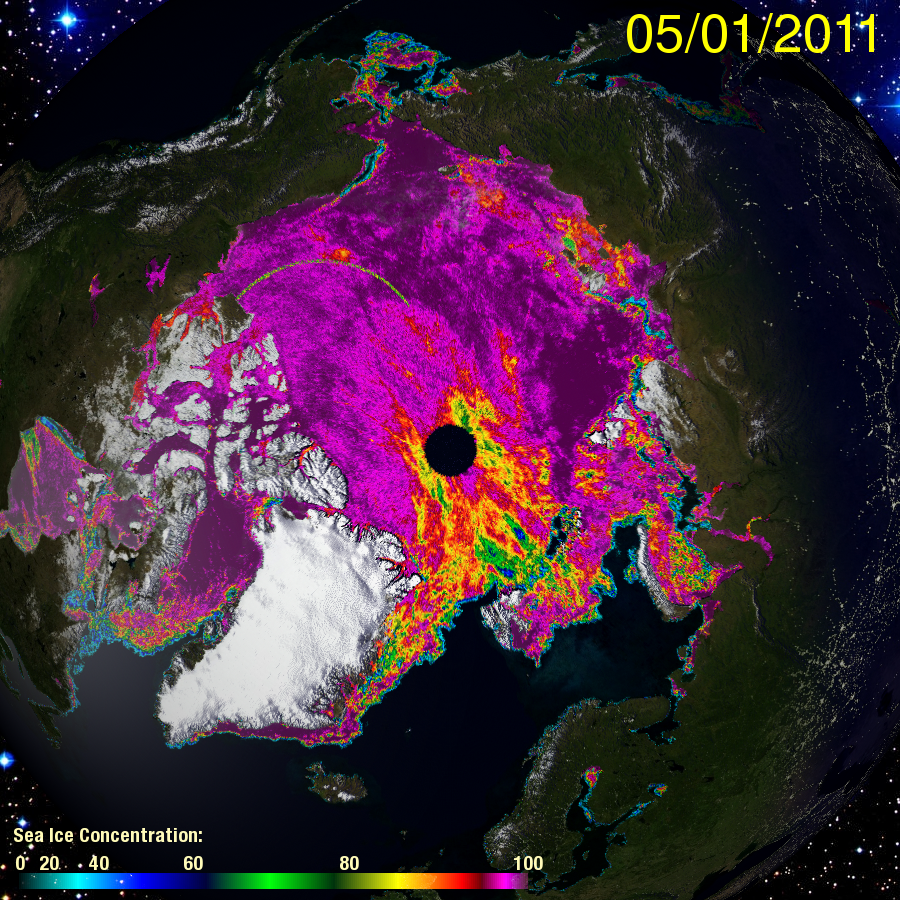 |
| Satellite view of the Arctic from Cryosphere Today site. Note the multi-colored Arctic showing that the ice is not 100% covering the water. This is new. |
If you look at the ice area for May 1, 2007, you will see that the ice completely covered the ocean. The Arctic set a record low summer ice minimum. Since 2011 is starting with thinner and less ice coverage than in 2007 the record sea ice minimum should be easily broken this year.
I suspect that we are seeing a new pattern of ice melt. If this pattern repeats itself next year, then it is likely that it is a permanent change. Permanent, that is, until there is no ice in the Arctic.
Subscribe to:
Posts (Atom)